
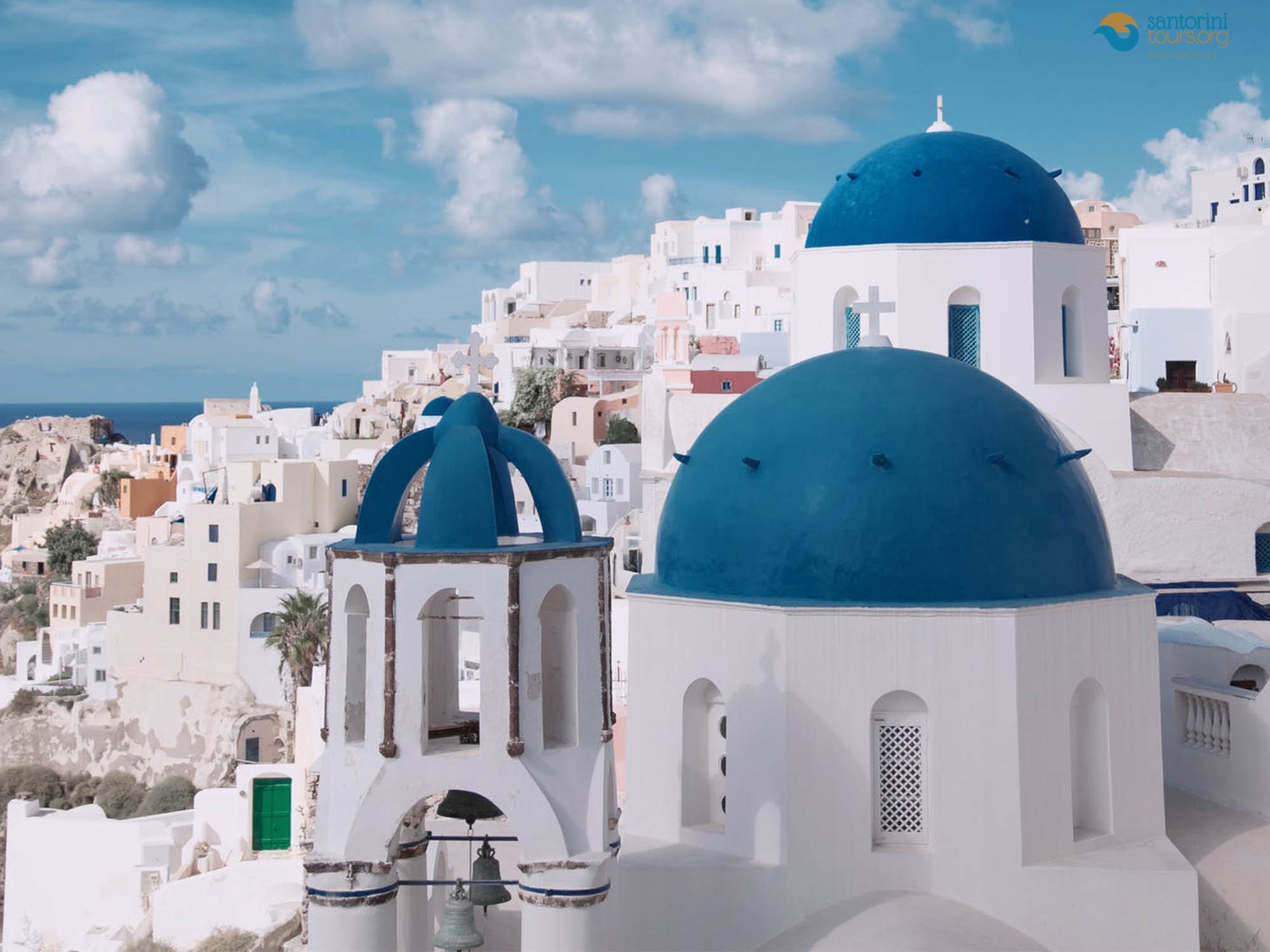
Santorini is among the most photographed places on earth and one of the hardest to photograph well. The images everyone knows — blue domes against a white village, a caldera burning orange, a lone figure on an empty terrace — were almost all made at hours when nobody else was there, from positions that take some finding, in light that lasts twenty minutes.
This guide is about getting those images rather than admiring them. Which locations work, what hour each one needs, how the crowds move, what equipment matters on an island of wind and glare, and how photography-focused santorini tours differ from the standard circuit.
For travellers planning the island, santorini tours and santorini tours offer expertly guided experiences across Santorini — from caldera sunsets and volcano walks to private wine tastings and tailor-made sightseeing.
What Makes Santorini Tours Hard To Photograph?
Extreme contrast, relentless crowds, and geography that puts most viewpoints facing the wrong way at the wrong hour.
On santorini tours the whitewashed walls throw enormous amounts of reflected light while the cave interiors and shaded lanes go almost black, which is a dynamic range problem in every frame. Midday sun flattens the caldera completely. And the famous locations are crowded from mid-morning until after sunset in season.
None of that is insurmountable, but it means the island rewards planning far more than improvisation. Photography-led santorini tours are built around the light rather than the map, which is the entire difference.
What Hour Should Santorini Tours Shoot Each Location?
Oia at dawn, Firostefani mid-morning, Vlychada in flat afternoon light, Pyrgos at golden hour, Imerovigli at blue hour.
On santorini tours each of those has a right window and looks ordinary outside it. The blue domes on Oia’s northern edge face north-west, so they work late in the day and read flat at noon. The Three Bells of Fira sits below the Firostefani path and needs morning light behind the camera.
Getting them in the correct order means reordering the day around the sun rather than the driving distances. No shared schedule can do that, which is why serious photographers on santorini tours book privately.
Where Are The Blue Domes?
On the northern edge of Oia’s main walkway, roughly halfway between the bus terminal and the castle.
On santorini tours there are three principal dome clusters, all photographed from the public path — no private property is involved, and climbing on rooftops is both unwelcome and unnecessary since the best angles are from the walkway itself.
The classic composition stacks two or three domes against the sea with the village falling away behind. It faces north-west, so late afternoon and sunset give the warm light, while dawn gives soft even light and, crucially, an empty path. On santorini tours arriving after eleven, this shot involves waiting for gaps between people.
What Is The Three Bells Of Fira?
A blue-domed church with a three-belled campanile on the Firostefani path, and probably the single most photographed building on the island.
On santorini tours it sits below the paved rim walk between Fira and Firostefani, shot from above looking down and out across the caldera. Morning is the window — the light comes from behind the camera and the domes hold their colour.
By afternoon it is backlit and the whites blow out. It is five minutes’ walk from Fira, which makes it one of the easiest serious images on the island to collect, and one that standard santorini tours regularly drive straight past.
Where Do Santorini Tours Find The Best Sunset Position?
Imerovigli or Skaros, not Oia — and the reason is compositional as much as practical.
Read more: Finikia Santorini Private Guided Transfers
On santorini tours the sun sets over the caldera from Imerovigli with Oia visible in the middle distance, lit up on its own headland. That gives depth and a subject. From Oia itself the sun sets over open water, which is beautiful to watch and comparatively hard to compose.
Imerovigli also has room to set up a tripod and a five-minute exit afterwards, where Oia has several thousand people on a two-metre walkway and a ninety-minute queue to leave. Photography santorini tours that end at Imerovigli are making the better choice on both counts.
Is Blue Hour Better Than Sunset Here?
Frequently, and almost nobody stays for it.
On santorini tours the twenty to thirty minutes after the sun drops are when the villages switch their lights on while the sky still holds colour, and the balance between ambient and artificial light is at its best. The caldera turns deep blue, the whitewash picks up the warm interior lights, and the crowd has already left.
Standard santorini tours depart at sunset because that is when the schedule says the day ends. Staying another twenty-five minutes produces the better image, and it is worth agreeing in advance with a private driver.
Where Should Santorini Tours Shoot At Dawn?
Oia — the only hour it is genuinely empty.
On early santorini tours the main walkway before eight is close to deserted, the marble is still in shade, and the light is soft and even. The domes read cleanly, the lanes have nobody in them, and the whole village is photographable in a way it simply is not after ten.
The trade is that the light is undramatic — sunrise happens behind the village rather than over the caldera, so this is a soft-light session rather than a golden one. For anyone whose priority is clean compositions of the famous locations, dawn on santorini tours is the single most valuable hour available.
What About Sunrise Over The Caldera?
It does not happen — the caldera faces west.
This surprises people planning santorini tours. The sun rises behind the rim villages over the eastern slope and the beaches, and sets over the water inside the crater. There is no caldera sunrise.
What you can shoot at sunrise is the east coast: Kamari and Perissa with the sun coming up out of the sea behind Mesa Vouno, or Ancient Thera on the ridge above them. Very few santorini tours run early enough for it, so it is generally a self-organised outing.
Which Village Photographs Best After Oia?
Pyrgos, at golden hour.
Read more: Faros Santorini Private Guided Transfers Beacon Akrotiri
On santorini tours Pyrgos is a medieval hilltop village of stepped lanes spiralling up to a Venetian castle, and the view from the top takes in both coasts. The stacked whitewashed houses catch late light beautifully, and there are almost no other photographers.
Megalochori is the alternative — neoclassical mansions, free-standing bell towers, wine caves — and it works in similar light. Emporio’s covered kasteli is a completely different proposition: a dark defensive maze that suits black and white and needs a fast lens. None of the three appear reliably on standard santorini tours.
What Is The Best Landscape Location?
Vlychada’s wind-carved cliffs, in flat afternoon light or under cloud.
On santorini tours the compacted volcanic ash is sculpted by wind and rain into columns, folds and overhangs — closer to the American southwest than to Greece, and unlike anything else in the Cyclades. Direct sun destroys the texture; overcast or late light brings out the forms.
Red Beach is the colour counterpart, shot from the marked overlook above rather than the beach, which has been closed and reopened repeatedly for rockfall. Both are on the southern route that santorini tours take toward Akrotiri.
Can You Photograph Inside Akrotiri?
Yes, without flash and without a tripod.
On santorini tours the site is roofed, which means low, even light and long exposures — a fast lens and high ISO tolerance matter more than anything else. The elevated walkways give clean overhead compositions of the streets and doorways.
Tripods are generally not permitted at Greek archaeological sites without a permit. The frescoes are not at the site but at the Museum of Prehistoric Thera in Fira, where photography rules vary and are worth checking on arrival. Guides on santorini tours will know the current position.
What Equipment Matters On Santorini Tours?
A wide lens, a polariser, something long for compression, and more lens cloths than you expect.
For santorini tours: wide, 16–24mm equivalent, for the lanes and the domes, where you cannot back up. A short telephoto or 70–200 for compressing the stacked villages against the caldera, which is where a lot of the strongest images come from and which almost nobody shoots.
A polariser cuts glare off the whitewash and deepens the sea. And the meltemi carries fine volcanic dust and salt spray, so cleaning cloths matter more than on a typical trip. Photographers on santorini tours consistently report the dust as the unexpected problem.
Read more: Exo Gonia Santorini Private Guided Transfers
Do You Need A Tripod On Santorini Tours?
For blue hour and interiors, yes. Otherwise it is a liability in the crowds.
On santorini tours the lanes are narrow and busy, and a tripod on the Oia walkway at sunset is genuinely antisocial as well as impractical. A compact travel tripod that fits in a daypack is the sensible compromise.
Where it earns its place is the twenty-five minutes after sunset from Imerovigli, and any long exposure of the caldera at night. Private santorini tours can accommodate the setup time; a shared minibus cannot.
How Do Santorini Tours Deal With The Crowds?
Arrive before them, run the circuit backwards, and use long exposures where you cannot.
The crowd curve santorini tours work against is steep and predictable: light until ten, heavy from eleven to two, easing until four, then compressing hard into the sunset window. Every standard itinerary runs Fira to Oia to sunset, so going the other way puts you in each place at its quietest.
Where people are unavoidable, a neutral density filter and a multi-second exposure will blur moving figures into nothing. It is the only reliable technique for the Oia walkway in August, and it needs the tripod that santorini tours rarely leave time for.
What Does A Photography Tour Actually Buy?
Waiting time — the ability to stand somewhere for twenty-five minutes while the light arrives.
That is the whole product of photography santorini tours. Locations are not secret; they are on every map. What no shared schedule can provide is the licence to stay at a viewpoint until a cloud moves, or to reorder the afternoon because the light went flat.
Private santorini tours with a driver briefed on photography cost €250–€600 for the group, and for two or three photographers that is the cheapest way to buy a day shaped entirely around the sun.
Which Season Is Best For Photography Santorini Tours?
Late September and October for the light; March and April for the landscape.
For photography santorini tours autumn brings longer golden hours, softer shadows and more atmospheric skies than the hard flat light of midsummer. The villages are quieter, which matters enormously when a composition depends on an empty lane.
Spring offers something different: green hillsides, wildflowers across the volcanic slopes, and a clarity in the air that summer haze removes. Both windows are better for santorini tours built around images than July or August, which offer reliable sun and the year’s worst crowds.
Read more: Emporio Santorini Private Guided Transfers
What About Drone Photography On Santorini Tours?
Heavily restricted, and the restrictions are enforced.
Beyond santorini tours, Greek regulations require registration for drones above 250g, and flying over crowds, near the airport or above archaeological sites is prohibited. Santorini’s airport sits in the middle of the island, which puts a substantial area inside controlled airspace.
Many hotels and villages also prohibit flying on their property. Anyone planning aerial work should check the current EASA and Greek CAA position well in advance rather than on arrival — no operator running santorini tours can authorise it on your behalf.
Where Do You Get The Empty-Terrace Shot?
Your own hotel, or Imerovigli early.
On santorini tours the images of a lone figure on a whitewashed terrace above the caldera are almost always taken at private accommodation, which is why they look impossibly empty. Caldera-view hotels in Firostefani, Imerovigli and Oia are the practical route to that image.
Failing that, Imerovigli’s public paths at dawn come close, and the walk out to Skaros gets you a foreground and a caldera with nobody in the frame within five minutes. Santorini tours rarely allow the time, which is what makes it a good use of a free morning.
How Do You Photograph The Caldera From The Water?
From a catamaran in the late afternoon, shooting back at the cliffs.
On land santorini tours you look across the crater from the rim; from a boat in the middle you are inside it, with three hundred metres of banded red, black and white cliff rising on three sides. The banding is legible in low light and washes out at midday.
Sunset from the water beneath Oia is the classic frame, and the boat is moving, so shutter speed matters more than aperture. Sea-based santorini tours returning along the caldera wall at sunset are the ones worth booking for this.
What Are The Most Overshot Locations On Santorini Tours?
The Oia castle at sunset, the three domes, and the windmills.
On santorini tours all three are genuinely worth photographing and all three have been photographed several million times. The images that stand out from Santorini now tend to come from the inland villages, the vineyards in their basket training, the Emporio kasteli, or Ancient Thera at dawn.
None of those appear on standard santorini tours, so they need a private itinerary and a specific request — which is exactly why the images are less common.
Read more: Athinios Santorini Private Guided Transfers
How Do You Handle The Extreme Contrast?
Expose for the whitewash and lift the shadows, or bracket and blend.
The defining technical problem on santorini tours is dynamic range. A whitewashed wall in full sun against a cave doorway is easily twelve stops apart, and getting both in one frame is not always possible in a single exposure. Blowing the whites is the worse failure, because there is no detail to recover and the wall is the subject.
The practical approach is to expose for the highlights, accept dark shadows in camera, and lift them in post — modern sensors carry enough shadow latitude for it. Where the range is genuinely impossible, bracket three frames and blend.
The other option is to avoid the problem: shoot at dawn, dusk or under cloud, when the range collapses to something a single exposure handles comfortably. Photography-led santorini tours schedule around this rather than fighting it at noon.
Santorini from the air: the caldera, the villages and the cliffs.
What Settings Work On Santorini Tours?
Aperture priority around f/8, ISO on auto with a ceiling, and exposure compensation dialled negative.
On santorini tours the whitewash fools most metering systems into underexposing badly — the camera sees a bright scene and pulls it toward grey, turning white walls muddy. One to two stops of positive compensation is often needed for a correct exposure, and the opposite in high contrast where the highlights need protecting.
f/8 gives enough depth for the stacked architecture without diffraction. Auto ISO with a floor shutter speed of around 1/250 handles the constant movement between bright lanes and dark passages.
None of this is exotic, but it is worth setting up before the first stop rather than during it, particularly on shared santorini tours where each village gets a fixed twenty-five minutes.
Is A Phone Camera Enough?
For most of it, yes — with two exceptions.
On santorini tours modern phones handle the wide village compositions and the high dynamic range better than they have any right to, and computational HDR is genuinely good at the whitewash-versus-shadow problem that defeats a single raw exposure.
Where they fall short is the compressed telephoto view of stacked villages against the caldera, which needs real optical reach, and long blue-hour exposures where a tripod and a proper sensor still win comfortably.
For a visitor on standard santorini tours who wants good images rather than portfolio work, a phone plus one early start will outperform an expensive camera used at eleven in the morning.
Read more: Transfer From to Airport Port Oia Finikia
Where Do Santorini Tours Photograph The Vineyards?
The belt between Pyrgos, Megalochori and Exo Gonia, in late afternoon light.
On wine santorini tours the vines are trained into low circular baskets — kouloura — pressed flat against the volcanic ground, with the fruit hanging inside the hollow centre. From a distance the fields read as rows of grey nests on pale ash, which photographs as something between agriculture and land art.
It is one of the most distinctive images available on the island and almost nobody shoots it, because the vineyards are inland and standard santorini tours stay on the rim. Late afternoon raking light picks out the basket forms; midday flattens them into scrub.
Most estates will let you walk into a parcel if you ask, and several include a vineyard walk with a tasting.
What Is Worth Shooting At Ancient Thera?
The ridge itself, the theatre, and the drop to both coasts.
Above the beaches on santorini tours, Ancient Thera occupies the spine of Mesa Vouno at 350 metres, with Kamari on one side and Perissa on the other and the sea visible in both directions. The Greek and Roman city is exposed rather than buried, so the streets, agora and theatre are all traceable in the stone.
It is best at dawn: the light comes up out of the sea directly ahead, the site is empty, and the heat has not arrived. The road up is a steep switchback and the walk from Kamari takes an hour.
Very few santorini tours include it, which is precisely why the images are uncommon.
Frequently Asked Questions About Photography
Can You Photograph Locals And Their Houses?
Ask first for people; be discreet about doorways. The villages are lived in, and residents in Oia have spent decades with cameras in their windows.
Is A Permit Needed For Commercial Shoots?
Yes, for archaeological sites and for organised commercial work. Personal photography needs nothing.
What Time Is Golden Hour?
Roughly 19:30–20:45 in June, 18:00–19:15 in September, 16:45–17:45 in December. Sunset moves by nearly three hours across the year.
Do Photography Tours Include Editing?
Some workshops do; standard santorini tours do not. Ask if that matters to you.
Read more: Transfer Fromto Santorini Airport Port Villages Except Oia Finikia
Is Oia Worth Shooting At All Now?
At dawn, absolutely. After ten it is a crowd-management exercise rather than a photographic one.
What Is The Single Best Frame On The Island?
Imerovigli at blue hour, with Oia lit in the distance. It has depth, a subject, colour and almost nobody standing in it.
How Do You Plan A Two-Day Photographic Itinerary?
Day one on land around the light; day two on the water in the late afternoon.
The land day of santorini tours starts before sunrise in Oia for the empty lanes, moves to Firostefani and the Three Bells while the morning light is still behind the camera, breaks through the flat middle hours at Akrotiri or the museum, then works inland to the vineyards and Pyrgos for golden hour and finishes at Imerovigli through sunset into blue hour.
The sea day is a catamaran departing mid-afternoon, shooting the banded cliffs from inside the caldera as the light drops and finishing with sunset from the water beneath Oia. That is the frame the rim cannot give you at any hour.
Two days built this way collect essentially every worthwhile image on the island. Most photographers who book standard santorini tours instead spend three days getting a weaker version of the same set, because the schedule dictates the hour rather than the light.
What Do Photographers Regret Not Doing?
Staying for blue hour, and going inland.
The twenty-five minutes after sunset is when the villages light up against a sky that still holds colour, and it is when the best-known images of Santorini are actually made. Almost every itinerary departs at sunset, and almost every photographer who leaves then regrets it once they see what the people who stayed came away with.
The second regret on santorini tours is spending all three days on the caldera rim. The vineyards, Emporio’s covered kasteli, Ancient Thera and the north-east coast produce images that do not look like everyone else’s, and they are quiet in any month.
Both are easy to fix in advance and impossible to fix afterwards, which is why they are worth raising with an operator when booking santorini tours rather than on the morning.
How Do You Photograph The Villages Without People?
Go at dawn, or use a long exposure and let them disappear.
There are only two reliable techniques. The first is timing: before eight in the morning the lanes of Oia, Firostefani and Imerovigli are effectively empty, and every composition that is impossible at noon becomes straightforward.
Read more: Santorini Tour Buses
The second is physics. A neutral density filter and an exposure of ten to thirty seconds turns moving people into nothing, leaving only the architecture. It needs a tripod and it needs the crowd to be moving rather than standing, which rules out the Oia sunset viewpoint where everyone is stationary.
Cloning people out in post is the third option and by far the most work. Photographers on santorini tours who solve it with an early alarm consistently come away with more usable frames than those who solve it at a desk afterwards.
What Should You Ask A Driver Before Booking?
Whether they will start before sunrise, run the route anticlockwise, and wait at a viewpoint for the light.
Those three answers separate a genuine photography day from a sightseeing day with camera stops. A driver who is comfortable with a 05:30 start in June and understands that twenty-five minutes at one viewpoint may be worth more than two extra villages is the one to book.
It is also worth stating the shot list in terms of light rather than places: dawn in Oia, morning at the Three Bells, flat light at Vlychada, golden hour inland, blue hour at Imerovigli. Operators running private santorini tours build the route from that easily; they cannot build it from a list of place names alone.
Expect to pay the standard private rate of €250–€600 for the group. There is rarely a photography premium — what changes is the schedule, not the vehicle.
Is A Workshop Worth It Over A Private Tour?
Only if you want instruction; for logistics alone, a private driver is cheaper and more flexible.
Photography workshops on the island run multi-day and include tuition, location scouting and often editing sessions, at a substantial premium. They suit photographers who want to improve rather than simply to collect images.
For anyone who already knows what they are doing, the value is entirely in access and timing, and that is available for the price of an ordinary private day. The locations are not secret and the light is not proprietary — what costs money is the willingness to be somewhere at half past five in the morning, which is exactly what private santorini tours are for.
What Should You Shoot On A Cruise Day?
Firostefani and the Three Bells in the morning, then the caldera from the tender on the way back.
A port day gives five or six usable hours after tendering and the cable car, which is not enough for a light-led itinerary. The realistic photographic goal is two good locations rather than a portfolio.
Read more: Santorini Horse Riding Tour
Firostefani is ten minutes from the cable car and delivers the island’s most recognisable church in correct morning light. Imerovigli is a further ten and gives the widest caldera view. Both are achievable before the ship’s crowd disperses across the island.
The underrated frame is the tender itself: crossing the caldera at water level with the villages strung 300 metres above on the rim is a perspective no land-based position gives, and everyone else on the boat is looking at their phone. Cruise-focused santorini tours cannot help with that one — it is simply a matter of sitting on the correct side.
How Does The Weather Affect The Shooting?
Cloud is a gift here, and the meltemi is the real obstacle.
Santorini gets almost no rain between June and September and something close to relentless clear sky, which sounds ideal and is not. Unbroken sun at midday flattens the caldera and blows the whitewash, and a day of thin high cloud produces markedly better images than a cloudless one.
The genuine problem is wind. The meltemi blows hard from the north through midsummer, and it carries fine volcanic dust and salt spray that gets into everything. Tripods vibrate, lens cloths run out, and long exposures at exposed viewpoints become difficult.
Shooting from sheltered positions — the eastern side of the rim villages, the inland villages, Emporio’s covered lanes — is the practical response, and any driver on private santorini tours will know which spots are out of the wind on a given day.
What Is The Best Position For The Windmills?
From the path west of Oia’s castle, with the village behind them.
The restored windmills at the western tip of Oia are among the island’s most photographed structures, and the standard frame — mill against sky — is the weakest available. Better is to walk past them toward the castle and shoot back east, putting the mill in the foreground with the whole village stacked behind it.
That composition needs late-afternoon light and it needs the crowd to have not yet arrived, which means shooting it around four rather than at sunset. On santorini tours that reach Oia in the morning it is available in soft light with nobody in the frame at all.
Where Do You Shoot The Caldera At Night?
From Imerovigli or Firostefani, an hour after sunset, with the villages lit below you.
Once blue hour ends the caldera goes genuinely dark — there is no development on the inner face and no light pollution from across the water. What remains is the strip of villages along the rim, glowing against black rock and black sea, which is a far stronger composition than most people expect.
Oia photographs well from Imerovigli at this hour because the distance compresses it into a band of light on a headland. A thirty-second exposure at a moderate ISO holds the highlights in the village while pulling detail out of the cliff.
Read more: Santorini Private Wine Tours
Astrophotography is viable outside the summer haze, particularly from Profitis Ilias or the inland villages away from the rim lighting. Nothing on standard santorini tours runs late enough, so this is a self-organised session or a specific request on a private booking.
What Are The Common Mistakes On Santorini Tours?
Shooting at noon, staying only on the rim, and leaving at sunset.
Midday produces the flattest, harshest light of the day and it is exactly when most itineraries reach the villages. The images look like snapshots because the light is doing nothing, and no amount of editing recovers a flat frame with blown whites.
Staying entirely on the caldera rim produces a set of images indistinguishable from everyone else’s, because the same four viewpoints have been shot several million times. The inland villages, the basket vineyards and Ancient Thera are where a distinctive portfolio comes from.
And leaving at sunset means missing blue hour, which is when the frame most people came for actually appears. Correcting those three habits improves the results from santorini tours more than any equipment decision.
How Much Time Do Photography Santorini Tours Need?
Three days minimum for the standard locations, five to include the inland and the sea.
One day gets you a compromise version of the famous shots. Two days, structured around the light rather than the map, covers essentially every worthwhile location on the rim plus the caldera from the water. A third day adds the inland villages and vineyards, and a fourth gives margin for a day of bad light.
What does not work is trying to combine photography with general sightseeing on the same schedule. The two want opposite things: sightseeing wants many stops in daylight hours, photography wants few stops at the edges of the day.
Booking one dedicated photographic day among otherwise ordinary santorini tours is usually the best compromise for travellers who are not on a photography trip but do care about the images.
The Short Version
Dawn in Oia while it is empty. The Three Bells mid-morning with the light behind you. Vlychada under flat light. Pyrgos at golden hour. Imerovigli for sunset and then stay for blue hour, which is when the image everyone wants actually appears.
Book privately, brief the driver that light comes before the itinerary, and accept that the day will look inefficient on paper. Photography-led santorini tours are not about seeing more places — they are about being in fewer places at exactly the right time.
Do Santorini Tours Provide Photography Guides?
A few operators run dedicated photo days; most simply provide a driver who understands the request.
The distinction matters less than it sounds. What a photographer needs on this island is access at the right hour and permission to wait, and a briefed driver delivers both at the standard private rate.
A specialist photo guide adds location scouting and composition help, which is worth paying for on a first visit or for anyone still learning. For experienced photographers the marginal value is small, and the money is better spent on a second day.
Read More
Discover more from Casinobet:
- Blog
- Crash Games
- Game Shows
- Hire an iGaming SEO Expert: What to Look For, What to Avoid, and How to Get Real Results
- How To Hire An Escort SEO Expert To Dominate Search Rankings
Contact
Santorinitours.org
Travel Agency In Greece
Karterados 847 00
6936914687